
Structured Products: Global Trends, Market Forces, and What Comes Next
In today’s rapidly shifting market environment, structured products are becoming an increasingly important component of modern portfolio construction. In a recent Numerix webinar, Structured Products in Focus: Global Trends & Market Forces, featuring Amélie Labbé, Chief Product Officer at Structured Retail Products (SRP), we explored the global trends, regional dynamics, and product innovations shaping the structured products landscape in 2026 and beyond.
What emerged is a clear picture: volatility, uncertainty, and investor demand are fundamentally reshaping how structured products are designed, distributed, and risk-managed. Below, we break down the key takeaways—and what they mean for market participants.
A Market Defined by Uncertainty—and Opportunity
The macro backdrop driving structured product activity remains highly dynamic. Markets across 2025 and into 2026 have been marked by uneven growth, persistent volatility, and geopolitical disruption. This has created an environment where traditional investment approaches are increasingly challenged.
For investors, this uncertainty translates into two dominant needs: protection and yield.
Structured products are uniquely positioned to address both. Their customizable payoff profiles allow issuers to engineer solutions that provide downside protection while still capturing income or upside potential. As a result, demand is shifting toward more flexible structures that can adapt to changing market conditions.
Accelerating Growth and Expanding Adoption
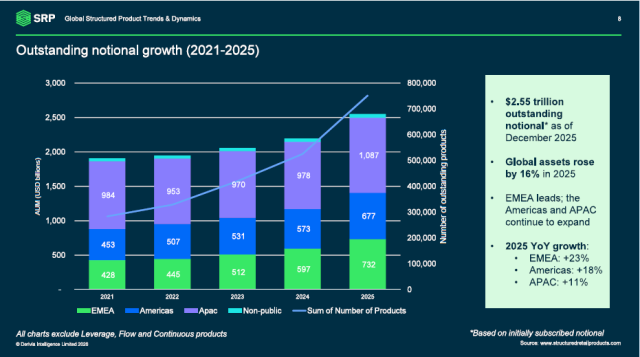
According to Labbé’s presentation, structured products are seeing a meaningful rise in global adoption, with outstanding notional estimated at $2.55 trillion. Growth has accelerated notably since 2021, particularly in Europe, where the market has expanded significantly, alongside strong momentum in the Americas and continued development across Asia-Pacific.
This growth reflects a broader shift in how structured products are perceived and utilized. They are increasingly being incorporated into portfolio strategies as investors look for ways to navigate uncertainty while maintaining targeted risk-return profiles. Their ability to deliver tailored outcomes is driving deeper integration across private banking, wealth management, and retail investment channels.
Source: Structured Retail Products
Three Key Trends Reshaping the Market
1. The Rise of Income and Capital Protection Strategies
In a volatile environment, investor preferences are shifting toward income generation and downside protection. This is driving sustained demand for structures designed to deliver regular payouts or preserve capital under a range of market conditions. At the same time, there is a growing emphasis on clearer, more easily understood payoff structures, as investors seek clarity and predictability in uncertain markets.
2. Regional Divergence in Product Design and Adoption
Structured product markets are evolving along distinct regional lines, shaped by local investor preferences, regulatory frameworks, and distribution models. Europe continues to lead in adoption, with structured products widely embedded in discretionary mandates and insurance wrappers. In the Americas, activity remains robust, driven largely by the U.S. market and ongoing innovation in product design. Across Asia-Pacific, growth continues as investor participation expands and product offerings become more sophisticated, reflecting a maturing market landscape.
3. Innovation in Product Formats and Distribution Channels
Innovation is accelerating across both product design and delivery. New formats such as structured ETFs are gaining traction, while advances in distribution technology are helping broaden access and streamline how products reach investors. There is also an increasing focus on transparency, standardization, and scalability, as market participants look to efficiently expand structured product offerings without sacrificing customization.
The Implications for Risk and Technology
As structured products grow in both scale and sophistication, the demands on pricing, risk management, and analytics are increasing significantly.
Many of the most widely used structures today, such as autocallables for example, are inherently complex, involving path dependency and multiple underlying risk factors. Accurately modeling these instruments requires not only advanced methodologies, but also the computational power to deliver results quickly and consistently.
Technology is therefore becoming a critical enabler. Firms must be able to ensure consistent pricing across the product lifecycle, deliver scalable risk analytics, and increasingly support timely responses to changing market conditions. Without a robust analytics framework, it becomes increasingly difficult to manage risk effectively or compete in a fast-evolving market.
What to Expect Going Forward
Looking ahead, several themes are likely to define the next phase of market evolution for structured products. Demand for outcome-oriented solutions is expected to remain strong, supported by continued market uncertainty and evolving investor expectations. Structured products will likely become more deeply integrated into core portfolio strategies, while innovation in formats and distribution channels continues to expand access and usability.
At the same time, firms will increasingly rely on advanced analytics, automation, and scalable technology to manage growing complexity and support global growth.
Turning Insight into Action
The structured products market is undergoing a period of significant transformation, driven by changing investor needs and a more complex macro environment.
For issuers and investors alike, success will depend on the ability to adapt to evolving demand, navigate regional differences, and leverage technology to manage complexity at scale.
At Numerix, we see this evolution firsthand. As markets become more dynamic and products more sophisticated, the need for integrated, high-performance analytics across pricing and risk has never been greater.
Structured products today are not just about engineering payoffs—they are about delivering precision, scalability, and insight in an increasingly uncertain marketplace.
Get Deeper Insight
Access the full on-demand webinar for additional detail, data and analysis on this topic: Structured Products in Focus: Global Trends & Market Forces

