
Asia-Pacific convertible issuance doubles year-over-year in Q2 2026
The global convertible securities market set an all-time record in Q2 2026, with issuance reaching $84.6B across 96 deals—a 67% increase over the same quarter a year earlier. While North America drove the headline totals, Asia-Pacific delivered one of the quarter's most compelling regional stories—extending a year-over-year growth trajectory that is steadily reshaping its role in the global market.
APAC issuers raised $13.2B across 23 deals in Q2 2026, up from just $6.2B across 10 deals in Q2 2025. That represents more than a doubling in both proceeds and deal count year over year, positioning the region as the second-largest contributor to global issuance—well ahead of EMEA's $7.3B, though still behind North America's $64.2B. Although issuance moderated from Q1 2026's $19.5B across 26 deals, the scale of that year-over-year expansion still marks a meaningful inflection point, reflecting the region's deepening capital markets and its growing influence on global convertible activity.
A broad-based regional expansion
Momentum in APAC was notable not only for its scale but for its breadth. Activity spanned Japan, Taiwan, South Korea, Australia, and China—evidence that the region's convertible market is deepening across multiple jurisdictions rather than concentrating in a single hub.
A notable feature of the quarter was the emergence of CNH-linked, USD-settled convertible bonds, with four such deals coming from Hong Kong-listed issuers pricing in U.S. dollars. This structure allows issuers to tap international demand while managing currency exposure, and its growing use signals that APAC issuers and investors alike are becoming increasingly comfortable with the structural flexibility convertibles offer.
Structural nuances shape the APAC market
APAC issuance carries distinct characteristics that set it apart from other regions. Notably, 17 of the region's deals came to market with one-year tenors—a reflection of local regulatory constraints that cap maturities for certain issuers.
These shorter maturities influence how APAC convertibles are structured, priced, and traded, and they underscore the importance of understanding regional regulatory frameworks when evaluating the asset class. Short-dated paper also brings issuers back to the market more frequently, which can accelerate deal counts and sustain a steady pipeline of activity over time. For global investors, the prevalence of these shorter tenors add layers of complexity and opportunity that differentiate APAC from the longer-tenor deals more common in North America and EMEA.
Lenovo anchors the region on the global stage
APAC's growing prominence was underscored by Lenovo Group, whose $2.0B convertible ranked among the 10 largest deals globally in Q2 2026—the only APAC issuer to break into the top tier. The deal priced with a 0% coupon and a 47.5% conversion premium, mirroring the issuer-friendly terms that defined the quarter's largest transactions.
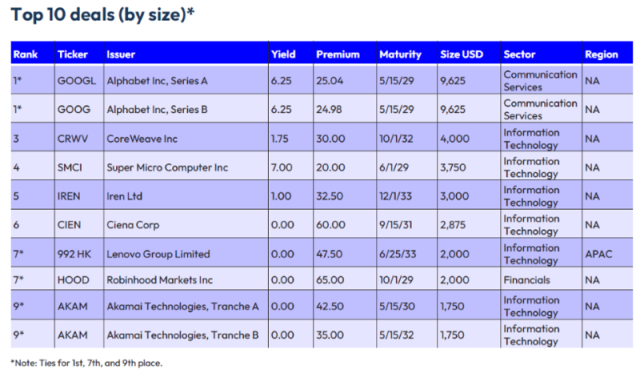
Lenovo's presence in the global top 10 is significant. It demonstrates that APAC issuers can execute at the scale and on the terms historically associated with North American technology names. Nor was Lenovo an outlier on pricing: 20 of APAC's 23 deals priced with a 0% coupon, evidence of just how issuer-friendly conditions were across the region, driven by strong investor demand and elevated single-name volatility.
APAC contributes across sectors
Beyond individual landmark deals, the sector mix behind APAC's issuance shifted markedly. The clearest signal came from information technology: after recording no IT convertible issuance in Q2 2025, APAC produced eight IT deals in Q2 2026—making technology the region's most active sector and mirroring the AI- and infrastructure-driven demand fueling the global market. Every one of those IT deals priced with a 0% coupon.
Materials followed with six deals tied to industrial supply chains and infrastructure-linked demand, while consumer discretionary, health care, industrials, and energy issuers rounded out a notably diversified quarter. This cross-sector participation reinforces a key theme: convertibles are no longer a niche financing tool in APAC but an increasingly mainstream option for a diverse range of issuers seeking flexible, cost-efficient capital.
The road ahead for APAC convertibles
The outlook for APAC issuance remains positive. New deals continued to price in the opening days of Q3, with Japan and Hong Kong among the markets already active—an early signal that the region's momentum is carrying into the second half of the year.
Several structural forces support continued growth. Higher-for-longer interest rates keep convertibles cost-competitive relative to straight debt, while AI-driven capital intensity is fueling financing demand across technology and infrastructure. As regulatory environments evolve and investor participation deepens—particularly in markets like Japan and South Korea—APAC is well positioned to build on its year-over-year gains.
While one quarter does not define a trend, the trajectory is clear: Asia-Pacific has moved from the periphery of the global convertible market toward its center, and the region's growing scale, breadth, and sophistication suggest that shift is likely to continue.
Explore the full Q2 2026 convertible market trends
For a complete view of global convertible issuance—including regional breakdowns, sector leaders, and the quarter's landmark transactions—download our latest market report.
Download the report here: Global convertibles issuance: key trends and insights Q2 2026
Frequently Asked Questions
Q1. How much did Asia-Pacific convertible bond issuance grow in Q2 2026, and what is driving the expansion?
APAC convertible issuance more than doubled year over year in Q2 2026. According to Numerix, issuers raised $13.2B across 23 deals, up from $6.2B across 10 deals in Q2 2025 — making the region the second-largest contributor to global issuance, ahead of EMEA's $7.3B and behind North America's $64.2B. Growth was broad-based across Japan, Taiwan, South Korea, Australia, and China, and led by technology: after zero IT deals in Q2 2025, APAC produced eight in Q2 2026. Higher-for-longer rates and elevated single-name volatility supported the surge, with 20 of the 23 deals pricing at a 0% coupon.
Q2. Why do so many Asia-Pacific convertible bonds carry one-year tenors, and how does that affect how desks price and manage them?
Short-dated paper is a defining feature of the APAC market. According to Numerix, 17 of the region's 23 deals in Q2 2026 carried one-year tenors — a reflection of local regulatory constraints that cap maturities for certain issuers. Shorter maturities bring issuers back to the market more often, sustaining deal flow, but add complexity for global investors managing cross-region exposure. Evaluating these structures means weighing regional regulation alongside embedded optionality — where convertible analytics like Kynex Core Analytics and the Kynex Portfolio Management System help desks price new issues, run scenarios, and track risk across a book of short-tenor deals.
Q3. What are CNH-linked, USD-settled convertible bonds, and why did Asia-Pacific issuers turn to them in Q2 2026?
CNH-linked, USD-settled convertibles reference offshore renminbi but settle in U.S. dollars, letting issuers tap international demand while managing currency exposure. According to Numerix, four such deals came from Hong Kong-listed issuers pricing in U.S. dollars in Q2 2026. Their emergence signals APAC issuers and investors are growing more comfortable with the structural flexibility convertibles offer — while adding a cross-currency layer that sets the region apart from the longer-tenor, single-currency deals common in North America and EMEA.

