
Turning risk management into a competitive advantage
Historically, risk management in financial institutions was built as a control function. Risk teams measured exposures, enforced limits, and reported breaches, operating separately from the trading and investing activities that generated returns. Accelerated by two decades of market crises, that mindset has now shifted. Leading banks and asset managers increasingly recognize that effective risk management can be a source of competitive advantage. Done well, it can prevent catastrophic losses, optimize risk-return trade-offs, and build greater confidence among stakeholders.
The shift goes beyond changing where risk sits within an organization. It changes the role of the risk function itself from monitoring exposures and enforcing controls to producing actionable insight that can shape business decisions. Modern risk teams are expected to translate complex market dynamics into intelligence the business can act on, whether at the trading desk, in capital allocation, or in product design. Risk management was once perceived as focused on what not to do, rather than enabling what could be done safely and effectively. Organizations succeeding in this new environment treat risk not as a back office obligation, but as a front office advantage.
Making risk a performance driver
The infographic below sets out five practical steps for transforming the risk function into a driver of performance, rather than a function focused on protection alone.
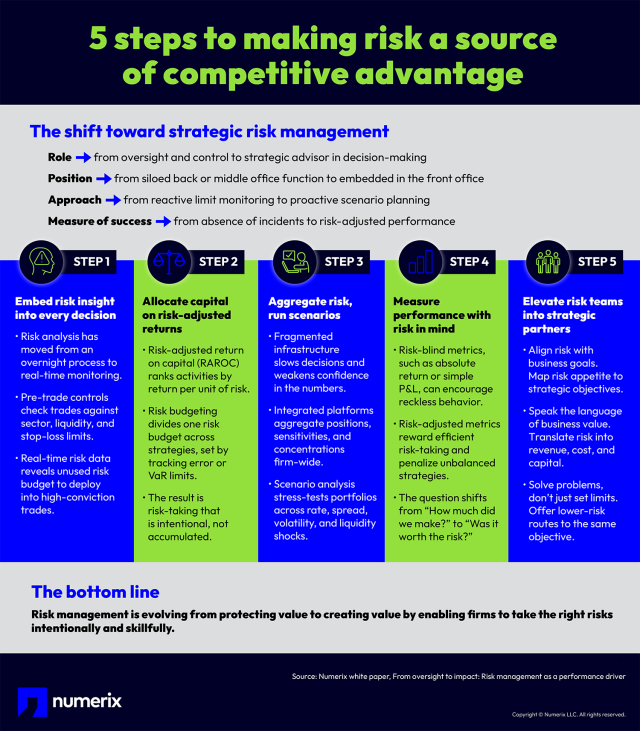
Balancing risk with reward
Being risk-driven means making deliberate choices about which risks to take, and balancing potential reward with the level of exposure and uncertainty involved. Integrated risk visibility, scenario analysis, and risk-adjusted metrics make that distinction easier to draw. They do not replace judgment but instead make it better informed and timelier.
For a closer look at the evolution of the risk function, including the tools, metrics, and organizational practices supporting this shift, read our white paper: From oversight to impact: risk management as a performance driver.
Frequently Asked Questions
Q1: How can risk management evolve from a control function into a driver of business performance?
A1: For decades, risk management operated as a control function, measuring exposures, enforcing limits, and reporting breaches separately from the trading and investing activities that generate returns. Leading banks and asset managers are now shifting that model, using risk insight to inform trading, capital allocation, and product decisions rather than simply restricting them. This shift asks risk teams to translate complex market dynamics into intelligence the business can act on, treating risk management as a front office advantage rather than a back office obligation.
Q2: What is the difference between risk management as a control function and risk management as a competitive advantage?
A2: A control function approach to risk management measures exposures, enforces limits, and reports breaches after the fact, largely separate from trading and investing decisions. A risk-driven approach instead makes deliberate, informed choices about which risks to take, weighing potential reward against the level of exposure and uncertainty using integrated risk visibility, scenario analysis, and risk-adjusted metrics. Numerix's white paper, From oversight to impact: risk management as a performance driver, outlines the tools, metrics, and organizational practices supporting this shift.
Q3: What steps can financial institutions take to turn risk management into a performance driver?
A3: Turning risk management into a performance driver takes more than relocating the function within an organization. It requires giving risk teams the tools to produce actionable insight that is connected and timely enough to shape trading, capital allocation, and product decisions. Numerix outlines five practical steps for making this shift in the infographic accompanying its white paper, From oversight to impact: risk management as a performance driver, covering the organizational practices, metrics, and technology needed to move risk from oversight to impact.

