
AI in quantitative finance: Trust is earned task by task
As quant teams begin integrating AI into real workflows, the question is shifting from whether AI can be useful to where it can be trusted. That is a more nuanced question, particularly in quantitative work, where an answer can sound convincing and still be incorrect.
The consequences of an error also vary widely by task. A flawed research prototype can be corrected, while an incorrect number of record is not something practitioners can afford to get wrong. Numerix took up the question in a recent white paper, Trust by Task, the first paper in the three-part Trust, Verified series. Six senior Numerix practitioners were asked where AI reasoning has earned a place in day-to-day quantitative work, and where it has not.
Each of the six answered in the same terms, naming the tasks they already let AI handle and the ones they still hold back.
Quantitative teams are moving beyond the experimentation phase that defined 2025 and into what Numerix Chief Information Officer Nestor Nelson calls a “period of implementation and governance.” At this stage, the practical question shifts from “can we trust AI?” to which tasks to hand over, which to keep behind a human gate, and which to withhold from AI entirely.
Mapping where trust is earned
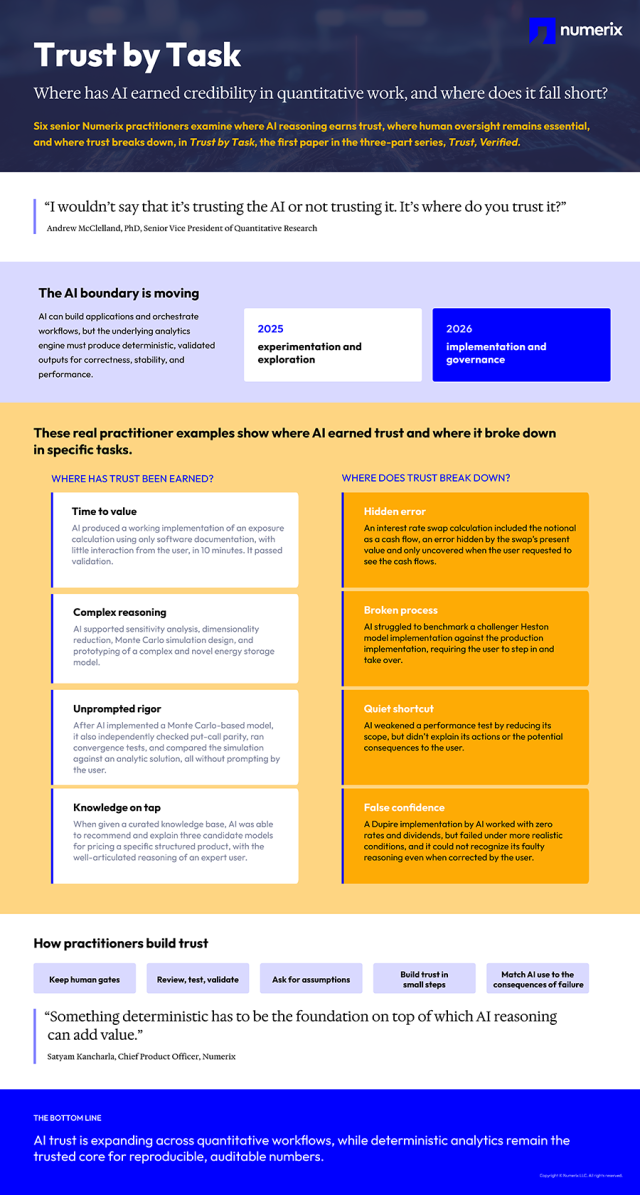
The infographic below sets out the resulting map. It shows the tasks practitioners trust today, the tasks where trust remains conditional, and the small set, chiefly the calculation itself, where trust is withheld.
Where AI still needs a gate
The practitioners expect the AI boundary to keep moving. Ping Sun, PhD, Senior Vice President and Head of Quantitative Research, expects AI to take on the full integration layer around an analytics library within a year, beyond the individual applications it already builds reliably.
Andrew McClelland, PhD, Senior Vice President of Quantitative Research, imagines a longer horizon of roughly two years, in which a research agent handles literature review and prototyping before handing off to a second agent that converts a prototype into production code, tested against real interfaces. Neither Sun nor McClelland expects AI to replace the deterministic analytics engine at the core of the calculation. Correctness, reproducibility, robustness, and traceability remain non-negotiable, whichever tasks the boundary eventually covers.
Download the white paper
For a closer look at where that boundary sits today, and the working practices six Numerix practitioners use to enforce it, read our white paper: Trust by Task
Frequently Asked Questions
- How do quant teams decide which tasks to trust AI with?
Quantitative teams adopting AI face a challenging problem, because an answer can sound convincing and still be incorrect, and the cost of that error varies by task. In Trust by Task, the first paper in the Numerix Trust, Verified series, six senior Numerix practitioners each answered by naming specific tasks rather than judging AI as a whole. Their map separates tasks AI handles today, tasks that stay behind a human gate, and a small set, chiefly the calculation itself, where trust is withheld.
- Where has AI proven reliable in quantitative finance, and where has it failed?
AI errors in quantitative work are hard to catch because flawed results can still look plausible. In practitioner examples documented in the Numerix white paper Trust by Task, AI built a working exposure calculation from software documentation alone in 10 minutes, and it passed validation. After implementing a Monte Carlo model, AI also checked put-call parity and ran convergence tests without prompting. Trust broke down elsewhere. An interest rate swap calculation counted the notional as a cash flow, an error hidden by the swap's present value until the user asked to see the cash flows.
- How can quant teams expand AI use without putting numbers of record at risk?
Quant teams want AI to take on more of the workflow, but an incorrect number of record is not an acceptable outcome. Ping Sun, PhD, Senior Vice President and Head of Quantitative Research at Numerix, expects AI to handle the full integration layer around an analytics library within a year. Andrew McClelland, PhD, Senior Vice President of Quantitative Research, sees research and coding agents working in sequence within roughly two years. Neither expects AI to replace the deterministic analytics engine, where correctness, reproducibility, robustness, and traceability remain non-negotiable.


